How to start and finish a thread without knots
Short answer
Do not knot it. A knot is a lump that shows through the fabric once the piece is mounted, and it works loose over years in a way a woven-in tail does not. For an even number of strands use a loop start: fold one long strand in half, thread both cut ends, and catch the loop with your first stitch. For a single strand use an away waste knot, a few centimetres from where you begin, and cut it off when you reach it. Finish every thread by running it under three or four stitches on the back and changing direction once.
Why not simply knot it
Three reasons, and the third is the one that gets people. A knot is thicker than everything around it, so when the work is laced over a mounting board it presses a visible bump into the front. Knots also come undone: not this month, but after a decade of being handled and hung, which is longer than the piece is meant to last unmaintained. And a back full of knots will not press flat, which means the front will not sit flat either.
The only knot that belongs on the work is one that gets cut off again, which is exactly what a waste knot is.
The loop start, for an even number of strands
This is the neatest start there is, and it works any time you are stitching with two strands — which on 14-count Aida is almost always.
- Cut one strand about twice your usual length, so roughly 90 cm.
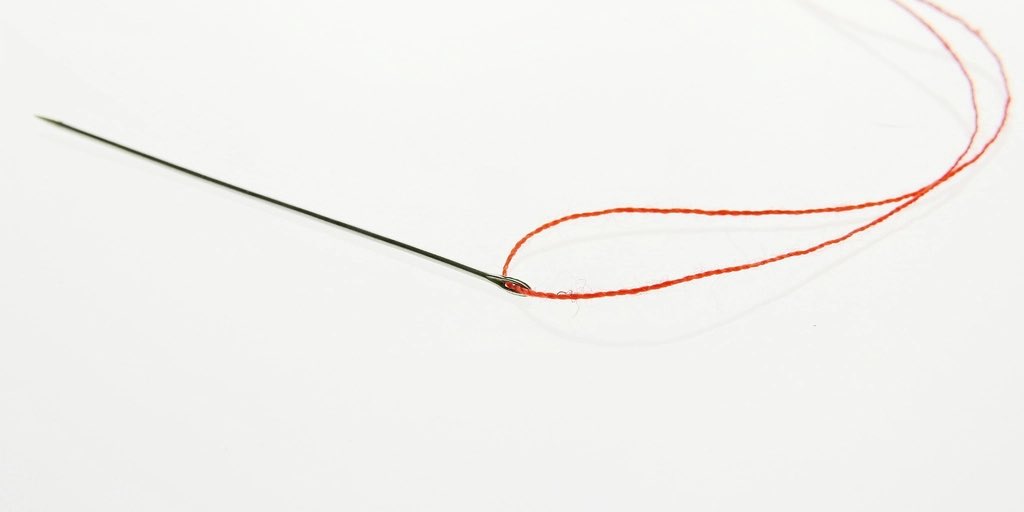
- Fold it in half and thread both cut ends through the needle. A loop hangs at the far end.
- Bring the needle up from the back at the first hole, leaving the loop underneath.
- Work the first diagonal of the stitch, take the needle down through the fabric, and pass it through the loop on the way.
- Pull it snug. The thread is anchored, with no knot and no tail to deal with.
- For four strands, fold two. Any even number works the same way.
The away waste knot, for one strand or three
An odd number of strands cannot be looped, so anchor it with a knot that is never part of the finished work.
- Knot the end of the thread and take the needle down from the front about 8 cm away from your first stitch.
- Put it in a direction you are going to stitch towards, not away from. That is what the away in the name is doing.
- Stitch as normal. The tail lies along the back and gets covered by the stitches you make.
- When your stitching reaches the knot, snip it off flush with the fabric and weave the freed tail under the back of the nearby stitches.
Finishing a thread
- Take the needle through to the back and run it under three or four stitches of the same colour.
- Change direction once, so the tail cannot slide back out the way it came.
- Cut it close. A long loose tail wanders around the back and shows through pale fabric.
- Do not run a tail under stitches that are much darker or much lighter than it. The shadow shows from the front.
What the back should look like
Not tidy — consistent. No knots, no loose ends longer than a centimetre, tails woven in rather than trailing, and nothing carried a long way behind unstitched fabric. A back like that presses flat and mounts flat, which is the only reason any of it matters. Nobody is going to look at it.
When a thread runs out mid-area
Finish it under nearby stitches of the same colour as usual, then start the new length a stitch or two away from where the old one ended and work back across the join. Starting in exactly the hole you stopped at piles four tails into one place, and that is the thick spot you can feel through the front years later.
Common questions
- Can I just tie a knot?
- You can, and it will hold for a while. But a knot presses a bump through to the front once the piece is mounted, and it loosens over years. A tail woven under three or four stitches holds better and lies flat.
- What is a loop start?
- Folding one long strand in half, threading both cut ends, and catching the loop with your first stitch. It anchors two strands with no knot and no tail, and works for any even number of strands.
- How do I end a thread in cross stitch?
- Run it under three or four stitches of the same colour on the back, change direction once so it cannot pull out, and cut it close.
- Does the back of cross stitch have to be neat?
- It has to be flat, which is not the same thing. No knots, no long loose ends and no long carries. Beyond that, nobody sees it.
Turn your own photo into a pattern
Upload a picture and the chart builds in your browser — DMC colours, finished size and thread list, before you pay for anything.

Read next
Updated 06/10/2026