How many strands of thread, and which needle?
Short answer
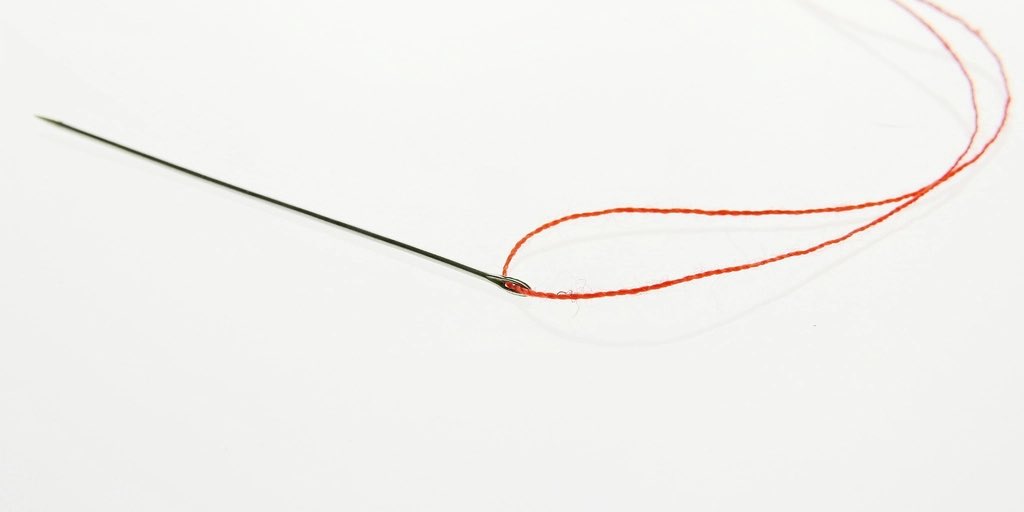
On 14-count Aida: two strands out of the six in a skein, and a size 24 tapestry needle. That is the default almost every chart assumes, including the skein estimates in these patterns. Coarser fabric needs a strand more to cover it and a bigger needle; finer fabric needs less of both. The needle has to be blunt — a tapestry needle pushes the woven threads apart, where a sharp one splits them and leaves the holes misshapen.
Strands and needle by fabric count
| Fabric | Strands | Tapestry needle |
|---|---|---|
| Aida 11 | 3 | 22 |
| Aida 14 | 2 | 24 |
| Aida 16 | 2 | 24 or 26 |
| Aida 18 | 1 to 2 | 26 |
| Aida 22 | 1 | 26 or 28 |
| 28-count evenweave or linen | 2 | 24 or 26 |
Needle numbers run backwards: the higher the number, the smaller the needle. Coverage is partly taste — if the fabric shows through more than you like, add a strand.
Why two is the default
Two strands fill a 14-count hole without crowding it. Three sit proud of the fabric and fight their way through, which shows as uneven tension. One leaves the fabric visible between the arms of the cross, which some people want and most do not.
The colour of the fabric changes the answer. Pale floss on black Aida almost always needs one more strand than the table says, because the dark ground shows through anything thin. Dark floss on white needs no such help.
Separating the floss, and why you have to
Cut your length first, then pull the strands apart one at a time and put the ones you want back together. Both halves of that matter: pulled apart and recombined, the strands lie side by side and cover the hole; taken off the skein as a pair, they stay twisted around each other and leave gaps.
The craft name for this is stripping the floss. It costs about ten seconds a length and it is the single biggest difference between work that looks finished and work that looks thin.
- Hold the cut length at the top and draw out one strand, letting the rest hang loose so they do not tangle.
- Never pull two at once: they knot around each other halfway up.
- Lay the strands together without smoothing the twist back in, and thread them as one.
How long a length to cut
About 45 cm, or elbow to fingertips. Shorter wastes thread in tails; longer is worse, because the last few stitches have been dragged through the fabric a hundred times and come out fuzzy and thin next to the first few. If the end of a length starts looking worn, finish it off and start another.
The needle
- A tapestry needle: blunt point, long eye. Not a sharp embroidery needle, which pierces the woven threads instead of parting them.
- The right size passes through the hole without being forced and without dropping through on its own.
- Gold-plated needles are not a luxury. Nickel plating corrodes in some people's hands within an evening, and a corroded needle drags and marks the floss.
- Replace a needle when it stops feeling smooth. They are cheap and a rough one shreds thread.
- The one exception to blunt: fractional stitches on Aida have to pierce the middle of a block, and that wants a sharp needle.
When to break the rule
- Backstitch outlines: one strand. Two only where you want a deliberately heavy line.
- Full coverage on dark fabric: one strand more than the table.
- French knots: two or three, so the knot has some body.
- Any fabric where you have stitched a test patch and did not like it. The test patch beats the table.
Common questions
- How many strands of floss for 14-count Aida?
- Two, out of the six in a DMC skein. Three on 11-count, one or two on 18-count, one on 22-count.
- What needle size do I need for cross stitch?
- A size 24 tapestry needle on 14-count Aida. Size 22 for 11-count, 26 for 18-count. Higher numbers are smaller needles.
- How many strands for backstitch?
- One. Backstitch is an outline, and two strands make a line that competes with the stitching it is supposed to define.
- Why does my cross stitch look thin and gappy?
- Either a strand short for the fabric, or floss that was taken off the skein as a pair instead of being separated and put back together. Separating it lets the strands lie flat and cover.
Turn your own photo into a pattern
Upload a picture and the chart builds in your browser — DMC colours, finished size and thread list, before you pay for anything.

Read next
Updated 06/10/2026